KPO's New Studio Facilities
Hale Brothers' Department Store, 1929
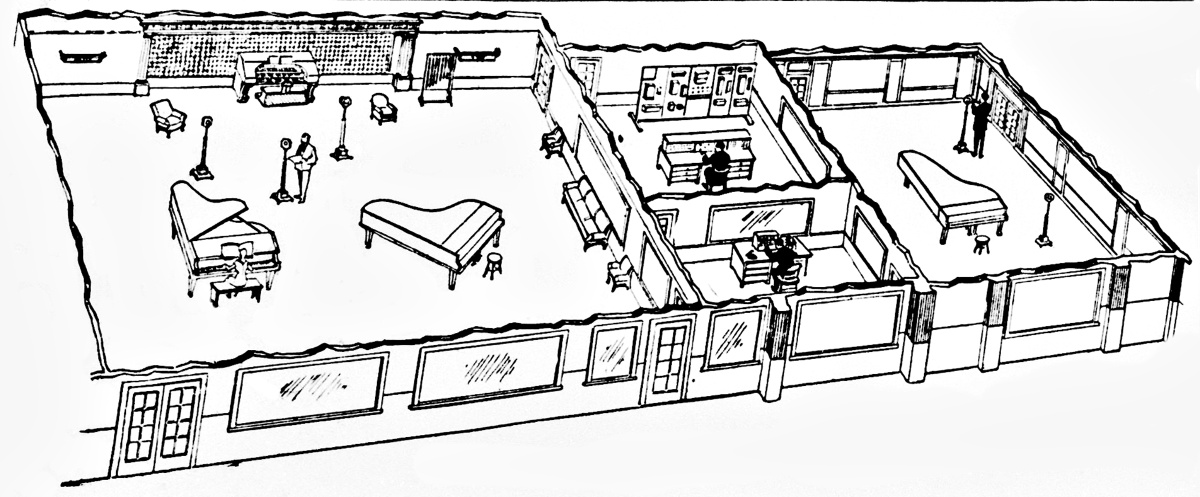
"KPO's new studio suite, representing the most modern ideas in broadcasting facilities, is virtually completed and will soon be ready for use. Two large studios, an announcer's booth, and a master control room are included in the suite. The announcer's booth is centrally located, and so designed that the announcer is able to see into every other room. A signal-light system and loudspeakers placed in each room permit the announcer, operator and performers to keep in instant touch with each other while the station is in operation. The new arrangement will improve the broadcasting from the Hale-Chronicle's station, allowing a quicker and smoother operation of each program, and preventing noise or interruption from spoiling its quality. In the above drawing of the new KPO studio layout, the studios are at the extreme right and left. The announcer's booth is shown in front between the two studios, with the master control room behind it. The operator in the control room can also see into each room of the layout. He will virtually control the broadcasting from the studios, shifting from one microphone to another as desired, and monitoring the volume output in his amplifiers. All programs originating outside the station will come to the control room to be transferred to the station's transmitting apparatus in the ninth story of the Hale Brother's addition building." (San Francisco Chronicle, 1929)
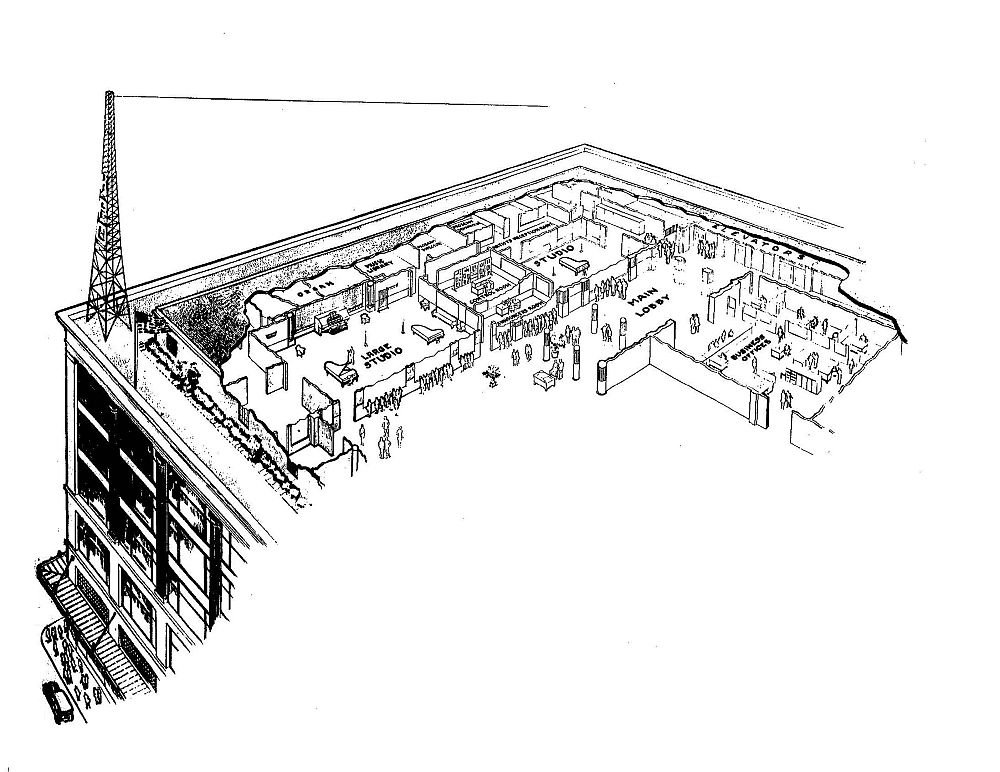
Jack Bethards has carried on intense investigations of the current
901 Market Street Building, the former Hale Brothers building.
Here are his discoveries:
"The original building had only
five floors, but was prepared to add a sixth. The roof structures above
the fifth floor were called a "temporary floor". There were "roof
buildings" or "penthouses" for some equipment. I presume the
first KPO studio was in another such roof building. The building
engineer and I presumed the enlarged 1929 studio was an expansion of
the roof building.
"Hale Bros. closed in 1942 and the
building was modified for J.C. Penney. I'll bet what remained of KPO
was just left to rot or was demolished. The building became
completely vacant in 1972. In 1984, the owners converted it into
a multi-tenant, retail/office center. There were so many foundation,
structural, permitting, and equipment problems that the building was
demolished, retaining only the façades. The current sixth floor dates
from 1985."
-- October, 2025